Let’s get the biggest misconception out of the way first. A saltwater pool is still a chlorine pool. The salt cell converts dissolved salt into chlorine through electrolysis, so the pool water stays sanitized the same way it always has, just without you carrying heavy chemical jugs or dealing with drastic concentration swings. The generator does the dosing automatically, and the result is softer water, steadier chemistry, and a significantly lighter weekly workload.
But lighter isn’t zero. Here’s what saltwater maintenance actually looks like in practice, and where people go wrong.
The Numbers You’re Managing
Before anything else, know your targets. Saltwater pools have the same chemistry parameters as any pool, with one addition: salt concentration.
| Parameter | Ideal Range | What Happens If It Drifts |
| Salt level | 3,000 – 4,000 ppm | Generator stops producing chlorine below ~2,700 ppm |
| Free chlorine | 1 – 3 ppm | Algae and bacteria move in |
| pH | 7.4 – 7.6 | Low pH corrodes equipment; high pH causes cloudy water |
| Total alkalinity | 80 – 120 ppm | Affects how stable your pH stays |
| Cyanuric acid | 70 – 80 ppm | Protects chlorine from UV degradation in sunlight |
| Calcium hardness | 200 – 400 ppm | Low calcium etches plaster; high calcium causes scaling |
The salt level feels like the new thing to manage, but in practice, it’s the most stable number on that list. You’re mostly topping it off after heavy rain or when adding fresh water to compensate for evaporation.
Week to Week
Testing twice a week is the right cadence for an actively used saltwater pool, especially in Texas summers. You’re checking free chlorine and pH every time. Alkalinity and salt level once a week is sufficient unless something looks off.
pH creeps up in saltwater pools more than in traditional chlorine setups. The electrolysis process itself tends to raise pH over time, so small downward adjustments with muriatic acid are a regular part of the routine. This isn’t a problem, it’s just the nature of the system. Staying on top of it weekly prevents the kind of pH drift that turns water cloudy or starts wearing on pool surfaces.
Skimming, brushing, and vacuuming work the same way they always have. The salt system naturally suppresses algae growth, so you’ll likely brush less often than with a traditional pool. That said, corners, steps, and shaded wall areas still benefit from a weekly pass.
The Salt Cell: The One Thing People Neglect
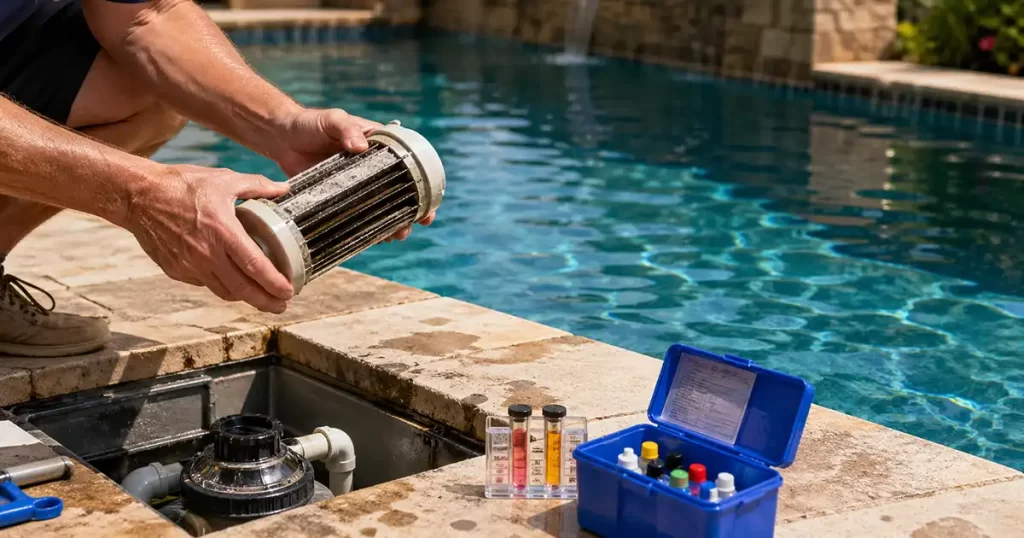
Every three months, the salt cell needs to come out for inspection and cleaning. Scale deposits build up on the cell plates over time, and a scaled-up cell produces less chlorine. You’ll notice it as gradually dropping free chlorine levels that don’t respond the way they should when you adjust the generator output.
Cleaning is straightforward. Remove the cell, rinse it with a garden hose, and soak it in a diluted muriatic acid solution if the buildup is significant. Inspect the plates for cracks or damage while you have it out.
A salt cell typically lasts three to seven years, depending on how well it’s maintained and how hard your water is. Replacing one runs $400 to $700. That cost is worth knowing ahead of time, so it doesn’t feel like a surprise when it comes.
What Throws Chemistry Off
Rain is the biggest disruptor in saltwater pool chemistry. A significant rainfall dilutes the pool water, drops salt concentration, and can shift pH and alkalinity in either direction depending on local water chemistry. After any heavy rain event, test everything and make adjustments before the next swim.
Heavy bather load has a similar effect. A pool party with a dozen people changes the chemical picture quickly. Test the day after.
Sunlight affects cyanuric acid levels over time. Cyanuric acid acts as a stabilizer that protects chlorine from UV degradation. If it drops below 50 ppm, your generator has to work harder to compensate because the chlorine it produces gets burned off faster. If it climbs above 90 ppm, it actually inhibits chlorine’s effectiveness. The fix is adding stabilizer when it’s low, or diluting with fresh water when it’s high.
Saltwater vs. Traditional Chlorine: The Real Maintenance Difference
Pool owners who switch from traditional chlorine to salt consistently report that the ongoing chemical costs drop dramatically. Annual chemical costs for a well-maintained saltwater pool run under $100, compared to $300 to $800 or more for a traditional chlorine pool of similar size. The tradeoff is that the generator and salt cell are more expensive to service than a basic chlorine feeder when something goes wrong.
The day-to-day experience is genuinely different, too. No more storing and handling concentrated chlorine products. No sudden spikes in chlorine levels after a manual dose. The water tends to feel softer and less irritating on the skin and eyes, which matters to anyone who swims regularly or has kids in the pool constantly.
Common Mistakes Salt Pool Owners Make
Neglecting pH is the biggest one. Because pH rises naturally in saltwater systems, some owners test less often, assuming the generator handles everything. It doesn’t. Left unchecked, high pH reduces chlorine effectiveness and eventually leads to cloudy water, scale deposits, and surface damage.
Adding the wrong kind of salt is another one worth knowing about. Pool-grade salt is what you want, a fine-ground, high-purity sodium chloride. Rock salt, Epsom salt, and anything with additives or anti-caking agents can damage the salt cell. The bag should say “pool salt” and nothing else.
Turning the generator up to compensate for low chlorine without checking why the chlorine is low is a short-term fix that often masks a real problem, whether that’s a dirty cell, high cyanuric acid levels, or a chemistry imbalance. Test first, adjust second.
FAQ
How salty does the pool actually feel?
Saltwater pools run at about 3,200 ppm of salinity. The ocean runs around 35,000 ppm. Most people describe the water as slightly silky rather than noticeably salty.
Can any pool be converted to saltwater?
Most can, yes. The main consideration is making sure pool equipment, light fixtures, and surrounding hardscape are compatible with a saltwater environment. Salt is corrosive to certain metals and some natural stone if not properly sealed. Our saltwater pool builder team can walk through compatibility before any conversion begins.
Does the CDC have guidelines on maintaining safe pool water chemistry?
Yes. The CDC’s Healthy Swimming resources at cdc.gov/healthy-swimming cover recommended chemical levels and testing frequency for residential pools.
What does a saltwater pool do to a travertine deck?
Salt splash on natural stone can cause pitting and surface damage over time if the stone isn’t sealed properly. Regular sealing is important for any natural stone surrounding a saltwater pool.
When should I call a professional for saltwater pool service?
Generator malfunctions, persistent chemistry problems that don’t resolve with standard adjustments, salt cell damage, and any visible scale buildup that isn’t clearing after a cleaning are all good reasons to bring in a pro. Our pool maintenance services cover saltwater systems across the Dallas-Fort Worth area.
You Didn’t Convert to Salt to Spend More Time on Maintenance
If your saltwater pool is giving you chemistry headaches instead of the easier experience you were expecting, something is off. It might be the generator output, the salt level, a pH issue, or a cell that needs attention. Call us at (469) 583-6213 or message us here, and we’ll figure out what’s going on.