
Here’s the short version: it costs more. Almost every time.
The savings look real on paper. A cheaper plumber, a buddy who “knows plumbing,” or just splitting the job up to save on labor costs. But outdoor kitchen plumbing is more involved than most homeowners expect, and when it goes wrong, it goes wrong inside walls, under countertops, and beneath cement board you just paid to have installed.
The Dream Outdoor Kitchen Has a Lot Going On Underneath It
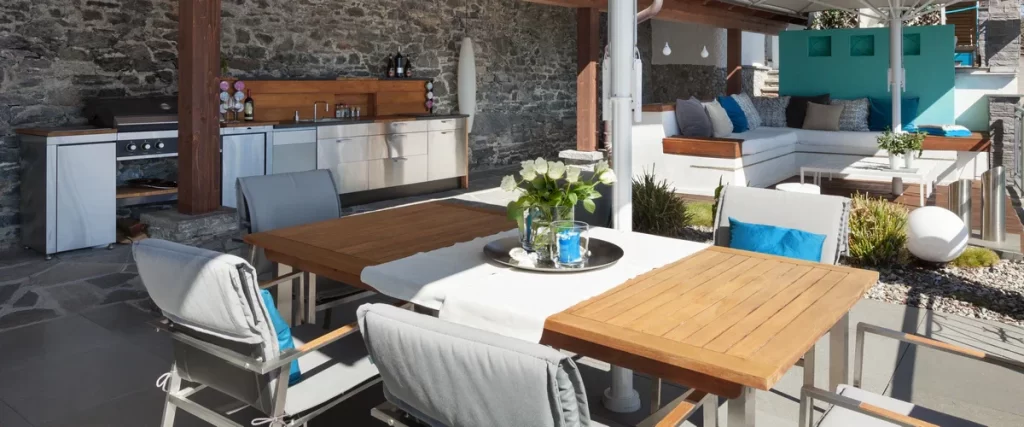
You’re picturing the gas grill, the natural stone countertops, the outdoor sink, maybe an ice maker for entertaining guests. That’s the fun part.
What’s less fun is that all of it needs water lines, a drainage system, gas line connections, and sometimes hot water running to a space that lives outside year-round, exposed to every environmental factor your climate throws at it.
This isn’t indoor kitchen plumbing with a view. Outdoor installations need materials rated for temperature swings, UV exposure, and moisture in ways that standard indoor components simply aren’t built for.
Get that wrong and you’re not just fixing a leak. You’re tearing out work you already paid for.
What It Actually Costs to Plumb an Outdoor Kitchen
Before we talk about what goes wrong, here’s what professional installation runs in 2026:
| Feature | Typical Cost |
| Running a water line | $450 to $1,800 per fixture |
| Drainage system | $10 to $25 per linear foot |
| Gas line (natural gas) | $15 to $50 per linear foot |
| Outdoor sink installation | $330 to $1,300 total |
| Ice maker installation | $494 to $599 per unit |
None of those numbers are unreasonable. What makes them expensive is paying them twice because the first job wasn’t done right.
The Permit Problem Nobody Mentions Until It’s Too Late
If your outdoor kitchen includes a sink, ice maker, or any water lines at all, you need a plumbing permit.
That’s not optional.
Connecting water supply lines and drainage systems to your home’s existing plumbing requires a permit in most jurisdictions.
Your local requirements vary, and you can find your municipality’s building department through USA.gov’s local government directory. What’s allowed in one city may not be in the next.
Skip the permits, and the consequences are concrete: fines, forced demolition of noncompliant work, and a problem that surfaces when you go to sell your house. None of that is hypothetical.
What Happens When Your Plumber Doesn’t Know the Whole Project
This is where hiring separately really breaks down.
Your plumber shows up without knowing where the grill is going, how the countertops are being framed, where the propane tank sits, or how the other appliances are being positioned. They do their job in isolation.
Then the contractor shows up and finds:
- Water lines running directly through where the cabinet frames need to go
- Drainage placed without accounting for the patio slope, so water pools instead of draining
- Gas line rough-in that conflicts with the grill placement by six inches, which might as well be six feet
- No coordination on the cement board, so the plumber improvised in ways that compromise the framing
Each one of those is a paid repair. Sometimes more than one.
Licensed vs. “Someone Who Knows Plumbing”
44 states require a plumbing license for major work like installing new plumbing lines, and hiring an unlicensed plumber can cost far more than the original invoice through structural damage, denied insurance claims, and health risks. USDA Plant Hardiness Zone Map
Insurance companies have refused to cover water damage caused by unlicensed work. No recourse, no coverage, just an out-of-pocket repair bill.
Licensed plumber rates in 2025 run $45 to $200 per hour, with most projects landing between $75 and $150, covering labor, insurance, licensing, and business overhead.
The low end of that range exists for a reason. Less experience, no insurance, or both. That’s what you’re usually getting when the number feels too good.
The True Cost of “Saving” on Plumbing
| Scenario | Apparent Savings | What Usually Happens | Real Cost |
| Unlicensed plumber, no permits | $500 to $1,500 upfront | Fines, failed inspection, rework | $2,000 to $8,000+ |
| Separate plumber not coordinating | Slightly lower labor | Rerouting, delays, reinstallation | $1,500 to $5,000 |
| Plumber unfamiliar with outdoor work | Lower hourly rate | Drainage failures, leaks, pipe damage | $2,000 to $7,000 |
| DIY on gas or water lines | No labor cost | Code violations, voided insurance, safety risk | Varies widely |
The pattern is the same every time. Savings upfront, more money before the project is done.
Where You Can Bring Your Own Stuff Without It Becoming a Problem
Plenty of homeowners want to supply their own appliances, and that’s usually fine.
Already bought a gas grill? Most contractors can work with it. Picked out your own countertop material? Natural stone, concrete, tile, bring it. These are areas where your preferences can lead without creating complications.
What gets tricky is supplying your own plumbing materials without knowing what’s rated for outdoor use. PVC fittings, connectors, and water lines all have outdoor-rated versions. Using indoor materials outside leads to faster degradation, more maintenance, and eventually a repair that costs more than the savings upfront.
FAQ
Can I hire my own plumber and still use a general contractor for everything else? Technically yes. In practice, it creates coordination issues, divided responsibility, and a contractor who may not warranty work they didn’t oversee. If the plumbing causes problems elsewhere in the project, untangling who owes what gets messy fast.
Does my outdoor kitchen really need its own dedicated plumbing? If you’re including a sink, ice maker, dishwasher, or hot water connection, yes. These aren’t features you can tap into casually. They need properly run water lines and a drainage system built for outdoor conditions.
Will unpermitted plumbing affect my home insurance? It can, and it has for other homeowners. Unpermitted or unlicensed work has resulted in denied claims for water damage. Talk to your insurer before making any changes to your plumbing.
Are there any plumbing tasks that are actually fine to DIY? Simple stuff like connecting a pre-run line to a fixture you’re swapping out can work. Installing gas lines, running new water lines, or building a drainage system from scratch are jobs for licensed professionals.
How much space does plumbing need in an outdoor kitchen layout? More than most people plan for. Clearance behind and below cabinet frames is a key factor in how your unique design actually gets built. Tighter layouts cost more to plumb, and that’s a conversation worth having early.
Honestly, This Is the Part Where We Just Say: Let Us Handle It
Building a dream outdoor kitchen for yourself and your loved ones should be exciting. Coordinating a separate plumber, chasing permits, and paying to redo a drainage system that pools every time it rains is not the experience anyone signed up for.
McKinley Construction Management handles the whole project, plumbing coordination, permitting, installation, all of it. No juggling multiple contractors. No hoping the work lines up.
If you want to see what a fully integrated outdoor kitchen build looks like, the outdoor living spaces page is a good place to start.
Ready to talk? Call us at (469) 583-6213 or message us here.